Robbins' version of the Stirling approximation

November 2022

The most beautiful formula in mathematics is certainly not the triviality 1+eiπ=01 + e^{i\pi}=0, as claimed by many tasteless mathematicians with no self-esteem, but rather Stirling's formula, stating that n!∼nne−n2πnn!\sim n^n e^{-n}\sqrt{2\pi n}. Quantifying the error of this approximation can be done to any precision using the Euler-MacLaurin complicated formula, but it is often handy to have a simpler estimation; Herbert Robbins[1] found one (original note here) which is surprisingly accurate:

e112n+1<n!nne−n2πn<e112n. e^{\frac{1}{12n + 1}} < \frac{n!}{n^n e^{-n} \sqrt{2\pi n}} < e^{\frac{1}{12n}}.

The inequalities are strict and valid for every nn. The proof of this result is given below. For future reference, we can compare (1) with the higher-order expansion: 

n!nne−n2πn=exp⁡{112n−1360n3+11260n5+O(1n7)}. \frac{n!}{n^n e^{-n}\sqrt{2\pi n}} = \exp \left\lbrace \frac{1}{12n} - \frac{1}{360n^3} + \frac{1}{1260n^5} + O(\frac{1}{n^7}) \right\rbrace.

Proof of (1)

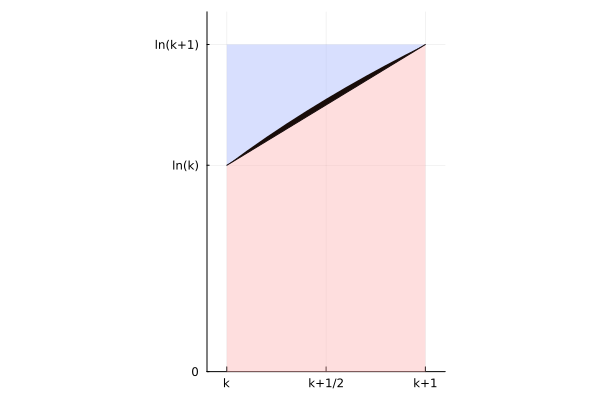
We have ln⁡(n!)=∑k=1n−1ln⁡(k+1)\ln(n!) = \sum_{k=1}^{n-1} \ln(k+1). Robbins' proof consists in a subtle approximation of ln⁡(k+1)\ln(k+1), as seen as the area of the rectangle [k,k+1]×[0,ln⁡(k+1)][k,k+1] \times [0, \ln(k+1)]. This area is equal to: 

sliver

Clearly, Tk=(ln⁡(k+1)−ln⁡(k))/2T_k = (\ln(k+1) - \ln(k))/2. We also recall that the antiderative of ln⁡(x)\ln(x) is xln⁡(x)−xx\ln(x) - x. Consequently, noting Sn=δ2+⋯+δn−1S_n = \delta_2 + \dotsb + \delta_{n-1},

ln⁡(n!)=I2+⋯+In−1+T2+…+Tn−1−Sn=∫1nln⁡(x)dx+12ln⁡(k)−Sn=nln⁡(n)−n+1+12ln⁡(n)−Sn.\begin{aligned} \ln(n!) &= I_2 + \dotsb + I_{n-1} + T_2 + \dotsc + T_{n-1} - S_n\\ &= \int_1^n \ln(x)dx + \frac{1}{2}\ln(k) - S_n\\ &= n\ln(n) - n + 1 + \frac{1}{2}\ln(n) - S_n. \end{aligned}

Estimating SnS_n

How big is SnS_n? Well, first we can reckon the δk\delta_k: they are equal to IkI_k minus the area of the trapezoidal approximation of IkI_k, which is (ln⁡(k)+ln⁡(k+1))/2(\ln(k) + \ln(k+1))/2:

δk=∫kk+1ln⁡(x)dx−ln⁡(k)+ln⁡(k+1)2=(k+1)ln⁡(k+1)−(k+1)−kln⁡(k)+k−ln⁡(k)+ln⁡(k+1)2=−1+ln⁡(k+1k)(k+0.5).\begin{aligned}\delta_k &= \int_k^{k+1}\ln(x)dx - \frac{\ln(k) + \ln(k+1)}{2}\\ &= (k+1)\ln(k+1) - (k+1) - k\ln(k) + k - \frac{\ln(k) + \ln(k+1)}{2}\\ &= -1 + \ln\left(\frac{k+1}{k}\right)(k + 0.5). \end{aligned}

Robbin's trick

Now you might want to develop the determinant as ln⁡(1+k−1)=k−1+k−2/2+…\ln(1 + k^{-1}) = k^{-1} + k^{-2}/2 + \dots: don't do this. Instead, do the following dark magic: first, note that k+1k=1+x1−x\frac{k+1}{k} = \frac{1 + x}{1-x} where x=(2k+1)−1x = (2k+1)^{-1}. Then, use the analytic formula

ln⁡((1+x)/(1−x))=2∑ℓ=0∞x2ℓ+12ℓ+1\ln((1+x)/(1-x)) = 2\sum_{\ell = 0}^\infty \frac{x^{2\ell +1}}{2\ell +1}

so that

δk=−1+1x(x+x33+x55+x77+⋯ )=−x23−x45−x67−⋯=−13(2k+1)2−15(2k+1)4−17(2k+1)6−⋯\begin{aligned} \delta_k &= -1 + \frac{1}{x}\left(x + \frac{x^3}{3} + \frac{x^5}{5} + \frac{x^7}{7} + \dotsb \right)\\ &= - \frac{x^2}{3} - \frac{x^4}{5} - \frac{x^6}{7} - \dotsb \\ &= - \frac{1}{3(2k+1)^2} - \frac{1}{5(2k+1)^4} - \frac{1}{7(2k+1)^6} - \dotsb \end{aligned}

We now use this to bound δk\delta_k below and above.

Upper bound

Since 3,5,7,9…3,5,7,9\dots are all greater than 3,

−δk<13(2k+1)2+13(2k+1)4+13(2k+1)6+⋯=13(2k+1)211−(2k+1)−2=112k(k+1)=112k(1k−1k+1).\begin{aligned} - \delta_k &< \frac{1}{3(2k+1)^2} + \frac{1}{3(2k+1)^4} + \frac{1}{3(2k+1)^6} + \dotsb \\&= \frac{1}{3(2k+1)^2}\frac{1}{1 - (2k+1)^{-2}}\\&= \frac{1}{12k(k+1)}= \frac{1}{12k}\left(\frac{1}{k} - \frac{1}{k+1} \right). \end{aligned}

Lower bound

On the other hand, 3,5,7,9…3,5,7,9\dots are smaller than 3,32,33,34…3,3^2, 3^3, 3^4\dots, so

−δk>13(2k+1)2+132(2k+1)4+133(2k+1)6+⋯=13(2k+1)211−(3(2k+1))−2=112((k+1/2)2−1/12).\begin{aligned} -\delta_k &> \frac{1}{3(2k+1)^2} + \frac{1}{3^2(2k+1)^4} + \frac{1}{3^3(2k+1)^6} + \dotsb \\&= \frac{1}{3(2k+1)^2}\frac{1}{1 - (3(2k+1))^{-2}}\\ &= \frac{1}{12((k+1/2)^2 - 1/12)}. \end{aligned}

It turns out that (k+1/2)2−1/12<(k+1/12)(k+1/12+1)(k+1/2)^2 -1/12 < (k+1/12)(k+1/12 + 1) (develop both sides then dismiss some terms), so that

−δk>112(1k+1/12−1k+1/12+1).-\delta_k > \frac{1}{12}\left( \frac{1}{k+1/12} - \frac{1}{k+1/12 + 1} \right).

Adding up

From the preceding bounds we see that the series δ1+δ2+⋯\delta_1 + \delta_2 + \dotsb is indeed convergent. If ss is its sum, Sn=s−∑k>nδkS_n = s - \sum_{k>n}\delta_k and using again the precedings bounds (they are telescoping), we can estimate:

s−112n<Sn<s−112n+1 s - \frac{1}{12n}< S_n < s - \frac{1}{12n+1}

Now go back last line of (1). Take exponentials to get n!/nne−nn=e1−Snn!/n^n e^{-n}\sqrt{n} = e^{1-S_n}. Then, with c=1−sc=1-s and the estimate above,

ec+112n+1<n!nne−nn<ec+112n. e^{c + \frac{1}{12n+1}}<\frac{n!}{n^n e^{-n}\sqrt{n}}< e^{c + \frac{1}{12n}}.

What about the constant ?

It's obviously not over, since we didn't get the constant cc. This, however, is usually done by another means, typically with the Wallis integral asymptotics as they here.


[1]  Herbert Robbins does not have the fame he deserves. He's the Robbins of the Robbins-Munro algorithm, the Lai-Robbins bound on bandit algorithms, the backward algorithm for the secretary problem: three essential contributions to different domains of statistics and computational mathematics. His book What is Mathematics ? with Courant is a masterpiece.